As an Amazon Associate I earn from qualifying purchases. Product links on this page are affiliate links, at no extra cost to you; see our Affiliate Disclosure.
Sometimes breastfeeding is not possible. When that happens, or when you decide to combine breast milk and formula, choosing an infant formula is one of the first feeding decisions you’ll make. Read on to learn why you might need infant formula, the different kinds of baby formula, and what to look for on the label.Disclaimer: This article is for general information and is not medical advice. Talk to your pediatrician before choosing or switching your baby’s formula.

Key Specs Compared
Numbers match the reviews below (tap to jump).
| # | Form | Size | Stated certifications |
|---|---|---|---|
| 1 | Powder | 21 Ounce | USDA Organic, Kosher |
| 2 | Powder | 32 Ounce | USDA Organic |
| 3 | Powder | 20.6 Ounce | USDA Organic, Non-GMO |
| 4 | Powder | 22.9 Ounce | USDA Organic, EU Organic, Non-GMO |
– = not stated on the Amazon listing · Specs and certifications as stated by the listing, not tested or verified by us; check the listing before you buy
Infant formula safety basics
- For babies under 12 months, use only an infant formula sold in the U.S., which must meet FDA nutrient and safety requirements.[1][2] Do not use toddler formula, homemade formula, or cow’s, goat’s or plant milk instead.[1][3]
- Mix powder exactly as the label says. Never water it down or add extra powder.[1][4]
- Choose an iron-fortified formula unless your pediatrician advises otherwise.[4]
- Ask your pediatrician before switching to a soy, lactose-reduced or hydrolyzed formula because of fussiness, gas or a suspected allergy.[4]
- Check FDA recall notices and register the can with the maker so you hear about any recall.[5]
When Do Mothers Use Formula Powder To Feed Their Babies?
Mothers use infant formula when they can’t breastfeed. Health experts recommend breast milk when possible, and an iron-fortified infant formula is the safe alternative for babies who don’t get breast milk.[4] Common reasons families use formula include:- Medical Conditions – Certain medical conditions or severe trauma can lead to an inability to produce breast milk. Some mothers have had breast surgery, and some babies are adopted or born to surrogates.
- Time – Many mothers do not have the luxury of breastfeeding because of work constraints and pressure. Returning to work can make breastfeeding or pumping hard, and many families combine breast milk with formula.
- Comfort – Some mothers do not feel comfortable breastfeeding their infants, and in some cases, breastfeeding can be painful.
Different Types of Organic Formula for Infants
Not all infant formulas are the same, and it is best to talk to your pediatrician before picking or switching one.[4]- Cow’s milk-based – Most infant formulas, organic or not, are made from cow’s milk protein that has been changed to make it suitable for babies. Most babies do well on a standard cow’s milk-based formula.[4]
- Reduced-lactose or “sensitive” – These formulas lower the lactose but still contain milk protein, so they are not for babies with a cow’s milk protein allergy. Lactose is a sugar, not the protein that causes milk allergy.[4]
- Soy-based – Soy formula is an option for families who avoid dairy for cultural or vegan reasons, or for babies with a rare condition called galactosemia. Some babies who are allergic to cow’s milk protein also react to soy, so ask your pediatrician first.[4]
- Hydrolyzed (“hypoallergenic”) – Babies with a diagnosed milk protein allergy usually need an extensively hydrolyzed or amino acid formula recommended by their doctor. These are generally not organic.[4]
Beneficial Components of Organic Infant Formula
Every infant formula sold in the U.S. must contain the nutrients the FDA requires, in set amounts, whether or not it is organic.[1][2] The USDA Organic seal tells you how the ingredients were grown and processed; it does not make a formula more nutritious.[6] Some ingredients you will see on labels:- Iron – Iron-fortified formula is recommended for babies who are formula-fed.[4]
- DHA and ARA – These fatty acids are found in breast milk and are added to most formulas. They are optional under FDA rules.[2]
- Lutein – A carotenoid found in breast milk that some brands add. It is also optional.
- Prebiotics – Some formulas add fibers such as GOS or FOS. Their benefits for healthy babies are still being studied, so they are a “nice to have,” not a must.[4]
What the Research Says
Breast milk is the recommended first food, and when a baby doesn’t get breast milk, infant formula is the only safe substitute in the first year.[4][3] All infant formulas sold in the U.S. must meet the same FDA nutrient requirements, so an organic formula is not more complete than a standard one; the organic label covers how the ingredients were produced.[1][2][6] Cow’s milk, plant milks, toddler drinks and homemade recipes don’t have the right balance of nutrients and can be dangerous for babies under 12 months.[3] If your baby has trouble with a formula (lots of spitting up, rash, blood in the stool or poor weight gain), talk to your pediatrician before switching, because these can be signs of an allergy or another condition.[4]How We Chose These Products
We don’t test products hands-on. We compared labels and listings: the type of formula (milk-based, reduced lactose), the USDA Organic seal [6], whether it is iron-fortified, and that it is labeled as an infant formula for 0 to 12 months. We removed products that were out of stock, no longer listed or recalled, and we checked the brands we list against recent FDA [5] recall notices in October 2026. None of the four formulas below was under an FDA recall when we checked, and all four appear on FDA’s list of infant formulas marketed in the U.S.[7] Brands don’t pay to be included, though we may earn a commission from purchases.Our Organic Infant Formula Picks
Below are the organic infant formulas we picked for babies under one year, based on their labels and listings.1
Earth's Best® Organic Sensitivity Formula Reduced-lactose organic formula with iron


- Earth’s Best’s reduced-lactose organic formula with iron comes in a 21 oz size.
- Certifications and seals include USDA Organic.
- It is meant for babies from 12 months and snacking; the package measures 5.1 x 5.1 x 4.9 inches and weighs 1.3 pounds.
- Made with organic milk; iron-fortified, with added DHA and Ara.
- It still contains milk protein (milk and soy are named as allergens[8]), so it is not for a baby with a diagnosed cow’s milk protein allergy.[4]
2
Earth's Best® Organic Dairy Formula Milk-based organic infant formula with iron


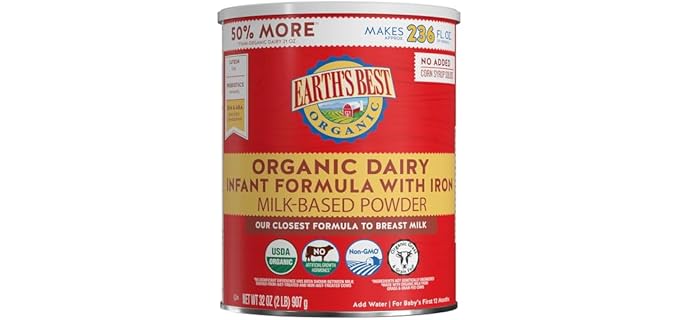
- This is a milk-based organic infant formula with iron from Earth’s Best, in a 32 oz size.
- Look for USDA Organic on the package.
- Use it for babies from 12 months and snacking; the package measures 5.2 x 5.2 x 6.8 inches and weighs 2 pounds.
- Iron-fortified, with added DHA and Ara.
3
Similac® Organic Infant Formula USDA Organic milk-based powder formula


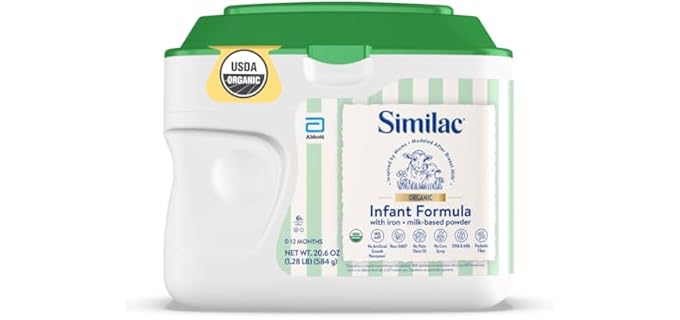
- You get 20.6 oz of USDA Organic milk-based powder formula.
- USDA Organic labeling is on the package, and it is non-GMO as well.
- Check the package label for the full ingredient list and allergen information before you buy.
- A milk-based infant formula made with USDA Organic ingredients.[6]
- Iron-fortified like other standard infant formulas.
4
Happy Baby® Organic Infant Formula Stage 1 organic milk-based formula


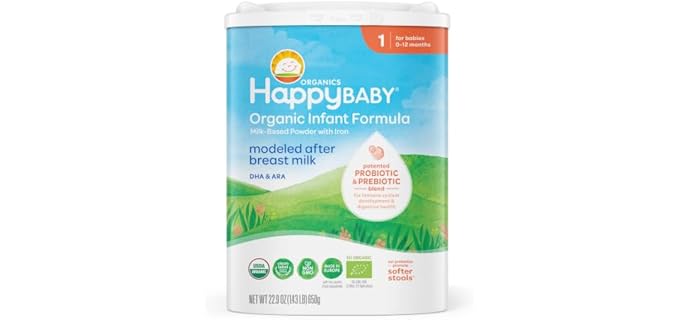
- This is a stage 1 organic milk-based formula from Happy Baby, in a 22.9 oz size.
- USDA Organic and EU organic labeling is on the package, and it is non-GMO as well.[6]
- Made with probiotics.
- Comes as powder (not liquid) in a 22.9-ounce container.[9]
- Iron-fortified, like other standard infant formulas.
Index Table: Organic Infant Formulas Compared
| No. | Product | Image | Features | Brand |
|---|---|---|---|---|
| 1 | Earth's Best Organic Sensitivity Formula - Reduced-lactose organic formula with iron |  |
| Earth's Best |
| 2 | Earth's Best Organic Dairy Formula - Milk-based organic infant formula with iron |  |
| Earth's Best |
| 3 | Similac Organic Infant Formula - USDA Organic milk-based powder formula |  |
| Similac |
| 4 | Happy Baby Organic Infant Formula - Stage 1 organic milk-based formula |  |
| Happy Baby |
Sources
- U.S. Food and Drug Administration. Infant Formula. Accessed October 16, 2026.
- eCFR. 21 CFR 107.100, Infant formula nutrient specifications. Accessed October 16, 2026.
- HealthyChildren.org (AAP). Why Formula Instead of Cow’s Milk?. Accessed October 16, 2026.
- HealthyChildren.org (AAP). Choosing a Baby Formula. Accessed October 16, 2026.
- U.S. Food and Drug Administration. Recalls, Market Withdrawals, & Safety Alerts. Accessed October 16, 2026.
- USDA Agricultural Marketing Service. Organic Labeling Standards. Accessed October 16, 2026.
- U.S. Food and Drug Administration. Infant Formulas Marketed in the U.S.. Accessed October 17, 2026.
- Amazon. Earth’s Best Organic Sensitivity Infant Formula (product listing). Accessed October 17, 2026.
- Amazon. Happy Baby Organic Infant Formula Stage 1 (product listing). Accessed October 17, 2026.
Update History
- Oct 2026: Product picks reviewed and updated; no products removed (all four in stock and not recalled); filled Key Specs, corrected Happy Baby to powder, added a milk-protein allergy note; added Sources (FDA, HealthyChildren.org (AAP), eCFR, USDA AMS, product listings)
- Aug 2017: First published