As an Amazon Associate I earn from qualifying purchases. Product links on this page are affiliate links, at no extra cost to you; see our Affiliate Disclosure.
Below we will discuss how organic self-tanners work, what ingredients you should avoid, and what you should look for. A self-tanner gives you color without UV exposure, which is safer than tanning in the sun or a tanning bed.Disclaimer: This article is general information, not medical advice. Patch-test new skin and hair products, and see a dermatologist for persistent skin problems.

Key Specs Compared
Numbers match the reviews below (tap to jump).
| # | Form | Size | Stated certifications | Fragrance |
|---|---|---|---|---|
| 1 | Lotion | 7.5 Fl Oz | Organic ingredients (not certified) | Not stated |
| 2 | Mousse | 8 Fl Oz | Organic claim (not certified) | Contains fragrance |
| 3 | Oil | 3.4 Fl Oz | Ecocert COSMOS Organic | Not stated |
| 4 | Serum | 2 Fl Oz | USDA-certified organic oils (product not certified) | Not stated |
| 5 | Lotion | 3.4 Fl Oz | 29.5% organic (maker) | Contains fragrance |
– = not stated on the Amazon listing · Specs and certifications as stated by the listing, not tested or verified by us; check the listing before you buy
Skin product safety
How Does Organic Self Tanner Work?
Back in the day, you had to work hard to get a decent tan. Tanning beds or spending long hours in the sun without getting sunburnt were the only means of doing it naturally. Self-tanners now come in versions made with organic plant oils and extracts. Many skip parabens or synthetic dyes, but some still contain fragrance, so check the label. Organic or not, they work the same way. The active ingredient in most self-tanners is dihydroxyacetone (DHA), a color additive that reacts with amino acids in the skin’s surface layer to make a brown color.[3] It doesn’t change your melanin, and the color fades over several days as those skin cells shed. Some brands make DHA from plant sugars such as sugar beet, but it works the same way as any other DHA. A self-tan doesn’t protect you from the sun unless the product contains sunscreen ingredients and is labeled with an SPF, so you still need sunscreen.[3] The FDA allows DHA only on the outside of the body; keep it away from the eyes, lips and mucous membranes, and avoid breathing in spray-tan mist.[3]5 Ingredients to Avoid in Organic Self Tanner
Some ingredient warnings online go further than the evidence. Here’s what regulators say:- Fragrance: Fragrance mixes are a common cause of skin allergies and irritation; choose fragrance-free if you have sensitive skin.[4]
- Parabens: The FDA says it has no evidence that parabens as used in cosmetics are harmful to health.[5]
- Phthalates: The FDA continues to review phthalates; most cosmetics no longer contain them except in some fragrances.[6]
- Formaldehyde releasers and certain preservatives: These can cause allergic reactions in some people.[7]
- Sulfates (SLS, SLES): Effective cleansers that can be drying or irritating for some skin types; they are not considered carcinogens.[7]
- Lead and contaminants: The FDA monitors contaminants in cosmetics, and measured levels in products like lipstick have been low.[8]
Ingredients in a Good Organic Self Tanner
Below we have discussed in brief five of the best ingredients that help to make your tan perfect, as well as nourish your skin!- DHA – DHA or dihydroxyacetone is the main active ingredient in ALL self tanners. It’s a simple sugar that reacts with amino acids in the top layer of skin to produce a bronze color; it doesn’t change your skin pigment.[3] Plant-derived DHA works the same as other DHA.
- Argan Oil – In self-tanners, argan oil has found a use to keep your skin well hydrated and add a golden glow to your skin.
- Plant oils and butters – Oils like jojoba, coconut and shea soften skin and help the tan go on evenly.
- Green Tea – An antioxidant extract found in some self-tanners. For an even tan, gently exfoliate the day before, for example with an organic oatmeal soap.
- Beta Carotenes – Beta carotenes are natural compounds found in orange vegetables like carrot, pumpkin and butternut. Some self-tanners add these orange pigments as a quick tint that washes off. They don’t tan skin the way DHA does, and rubbing in oils like sea buckthorn can stain skin and clothes orange.
What the Research Says
The FDA doesn’t define “organic” or “natural” for cosmetics; a product can carry the USDA Organic seal only if its agricultural ingredients meet USDA standards.[9][1] Plant ingredients can still cause allergic reactions, and fragrance is a common cause of skin irritation.[4] Cosmetics can’t legally claim to treat or cure skin conditions; products that do are regulated as drugs.[10]How We Chose These Products
We don’t test products hands-on. We compared labels and listings: ingredients and fragrance, what any organic claim covers (USDA seal or third-party certification) [11], skin type, and price per ounce. All five listings claim organic ingredients; TanOrganic is the only one certified organic as a whole (Ecocert COSMOS). On October 18, 2026 we checked these brands against CPSC [12] recalls and openFDA enforcement records[13] and found none. Brands don’t pay to be included, though we may earn a commission from purchases.Our Picks: Organic Self Tanners
Five self-tanners made with organic ingredients. We may earn a commission on purchases made through these links.1
Beauty by Earth® Self Tanner Lotion Moisturizing self-tanning lotion, natural ingredients


- You get 7.5 fl oz of moisturizing self-tanning lotion (natural ingredients).
- This one is vegan and cruelty-free.
- Key ingredients: aloe vera and coconut.
- It is dye-free.
- The package measures 2 x 2 x 7 inches and weighs 0.5 pounds.
2
Skinerals® Self Tanner Mousse Organic sunless tanning foam, face, body


- This is an organic sunless tanning foam, face, body from Skinerals, in an 8 oz size.
- It is vegan.
- It suits face and body.
- Patch-test a small area first and check the ingredient list for anything you react to.
- It contains fragrance, so patch-test first if you have sensitive skin.
3
TanOrganic® Self Tanning Oil Organic self-tanning oil for face, body


- This is an organic self-tanning oil for face (body) from TanOrganic, in a 100 ml size.
- Certifications include Ecocert and COSMOS Organic, and it is also vegan.
- Made with vitamin E, aloe vera and argan oil.
- Use it for face, body and hands.
4
Golden Star Beauty® Face Tanner Serum Self-tan serum with hyaluronic acid


- Golden Star Beauty Face Tanner Serum is a self-tan serum with hyaluronic acid, and it comes in a 2 fl oz size.
- USDA Organic labeling is on the package, and it is vegan, cruelty-free and gluten-free as well.
- It is paraben-free.
- A face tanning serum with hyaluronic acid and USDA-certified organic oils and extracts; the serum itself isn’t certified organic.
- It won’t slow aging, and it has no SPF, so it doesn’t replace sunscreen.[3]
5
The Organic Pharmacy® Self Tan Lotion Vegan streak-free self tan for face


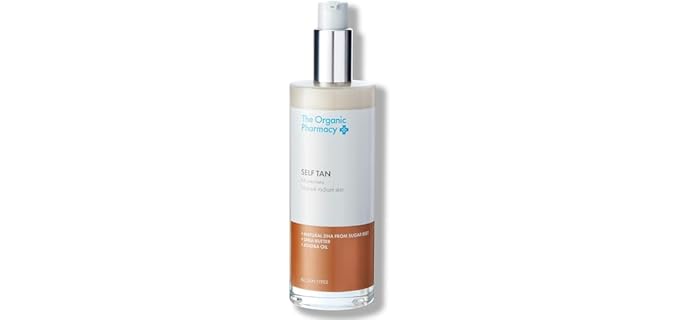
- You get 100 ml of vegan streak-free self tan for face.
- This one is vegan.
- Key ingredients: shea butter.
- It has a herbal scent.
- Use it for face, body and hands; the package measures 2 x 2 x 4.7 inches.
Comparison Table: Top Rated Organic Self Tanners
| No. | Product | Image | Features | Brand |
|---|---|---|---|---|
| 1 | Beauty by Earth Self Tanner Lotion - Moisturizing self-tanning lotion, natural ingredients |  |
| Beauty by Earth |
| 2 | Skinerals Self Tanner Mousse - Organic sunless tanning foam, face, body |  |
| Skinerals |
| 3 | TanOrganic Self Tanning Oil - Organic self-tanning oil for face, body |  |
| TanOrganic |
| 4 | Golden Star Beauty Face Tanner Serum - Self-tan serum with hyaluronic acid |  |
| Golden Star Beauty |
| 5 | The Organic Pharmacy Self Tan Lotion - Vegan streak-free self tan for face |  | The Organic Pharmacy |
Sources
- U.S. Food and Drug Administration. Cosmetics Labeling Claims. Accessed October 16, 2026.
- American Academy of Dermatology. How to wash your face. Accessed October 16, 2026.
- U.S. Food and Drug Administration. Sunless Tanners and Bronzers. Accessed October 18, 2026.
- U.S. Food and Drug Administration. Fragrances in Cosmetics. Accessed October 16, 2026.
- U.S. Food and Drug Administration. Parabens in Cosmetics. Accessed October 16, 2026.
- U.S. Food and Drug Administration. Phthalates in Cosmetics. Accessed October 16, 2026.
- U.S. Food and Drug Administration. Cosmetics Safety Q&A: Prohibited and restricted ingredients. Accessed October 16, 2026.
- U.S. Food and Drug Administration. Lead in Food and Foodwares. Accessed October 16, 2026.
- U.S. Food and Drug Administration. “Organic” Cosmetics. Accessed October 16, 2026.
- U.S. Food and Drug Administration. Is It a Cosmetic, a Drug, or Both? (Or Is It Soap?). Accessed October 16, 2026.
- USDA Agricultural Marketing Service. Organic Labeling Standards. Accessed October 16, 2026.
- U.S. Consumer Product Safety Commission. Recalls. Accessed October 16, 2026.
- U.S. Food and Drug Administration, openFDA. Drug Recall Enforcement Reports (searched October 18, 2026). Accessed October 18, 2026.
Update History
- Oct 2026: Kept all five (each listing claims organic ingredients) and clarified what each claim covers; corrected how DHA works (reacts with amino acids in the skin surface, not skin pigment) and that self-tan gives no sun protection; added FDA limits on DHA use (no eyes, lips, mucous membranes or inhaled spray); corrected beta-carotene claims; removed anti-aging claims; fixed broken ingredient list and Key Specs; Sources (FDA, AAD, USDA AMS, CPSC, openFDA)
- Jul 2021: First published