As an Amazon Associate I earn from qualifying purchases. Product links on this page are affiliate links, at no extra cost to you; see our Affiliate Disclosure.
Joint supplements are crowded with herbs, resins and turmeric blends, and the evidence behind them is thinner than the labels suggest. This guide covers what NIH says about turmeric, glucosamine and chondroitin, a liver safety warning that applies to high-absorption turmeric, and how five organic joint products compare by form, count and certification.Disclaimer: This article is general information, not medical advice. Talk to your doctor or pharmacist before you start a supplement, especially if you are pregnant, nursing, have a medical condition, take medicine or are buying for a child. Joint pain that is new, swollen, red or getting worse needs a diagnosis.

Key Specs Compared
Numbers match the reviews below (tap to jump).
| # | Form | Size / count | Stated certifications | Vegan |
|---|---|---|---|---|
| 1 | Tablets | 90 Count | USDA Organic, Non-GMO | Yes |
| 2 | Capsules | 180 Count | USDA Organic, Non-GMO | Yes |
| 3 | Capsules | 60 Count | Organic (no seal named) | Yes |
| 4 | Capsules | 180 Count | CCOF certified organic | Not stated |
| 5 | Tablets | 30 Count | USDA Organic, Non-GMO Project Verified, NSF Gluten-Free, Kosher | Yes |
– = not stated on the Amazon listing · Specs and certifications as stated by the listing, not tested or verified by us; check the listing before you buy
Joint supplement safety
- NCCIH says highly bioavailable curcumin formulas may harm the liver, and liver damage has been reported in some people who used them.[1]
- If you notice fatigue, nausea, poor appetite, dark urine or yellow skin or eyes, stop turmeric or curcumin products and talk to your health care provider.[1]
- Turmeric supplements may be unsafe during pregnancy, and little is known about breastfeeding. Check with your health care provider about interactions with any medicine.[1]
- Supplements are not approved by the FDA before they are sold.[3]
What the Evidence Covers
- Turmeric and Curcumin – NCCIH says researchers do not know enough to conclude that turmeric or curcumin helps any health condition. Studies on osteoarthritis exist, but the products and curcumin amounts vary widely.[1]
- Black Pepper – Pairing curcumin with piperine from black pepper is one way to improve how much curcumin the body absorbs, and it is also the type of bioavailable formula linked to liver damage.[1]
- Glucosamine and Chondroitin – These are parts of cartilage. Studies of them for knee osteoarthritis have had inconsistent results, and expert groups disagree on whether to recommend them.[2]
- Herbal Blends – Boswellia, guggulu and similar herbs, as in the Banyan Botanicals blend, have traditional use, but NCCIH’s pages on turmeric and on glucosamine and chondroitin do not cover them.
What to Check on a Joint Supplement Label
- Curcuminoids Per Serving – Curcumin products differ in how much curcumin they hold. Compare the curcuminoid amount on the Supplement Facts label, not the total turmeric amount.[1][3]
- Absorption Enhancers – Check for black pepper, piperine or BioPerine. Four of the five picks name one, and NCCIH’s liver warning applies to them.
- Organic Seal – Look for the USDA Organic seal for certified organic ingredients.[4] NatureWise is certified organic by CCOF.
- Allergens – Read the ingredient list for anything you react to, and check whether the capsule or tablet contains other herbs, such as ginger or probiotics.[3]
- Your Medicines – Show the label to your pharmacist before you combine a joint supplement with any medicine. For another gut-related supplement, see our organic probiotic picks.
What the Research Says
NCCIH says it is challenging to compare the evidence on turmeric because oral curcumin products vary in how much curcumin they hold and often contain other plant substances such as piperine.[1] Initial research on turmeric for osteoarthritis is positive, but higher-quality evidence is needed, and the effect of better absorption is not yet understood.[1] For glucosamine and chondroitin, studies of knee osteoarthritis have had inconsistent results, and the 2019 American College of Rheumatology and Arthritis Foundation guideline strongly recommended against them while a 2021 orthopaedic guideline named them as possibly helpful.[2]How We Chose These Products
We do not test products. We compare product details: form, amount per container, stated certifications, ingredients and availability.[3][4] Products that are out of stock stay as they are. Brands don’t pay to be included, though we may earn a commission from purchases.Our Organic Joint Supplement Picks
These five products are one herbal blend and four turmeric supplements, from 30 to 180 count. With every purchase through the links on this page, we may earn a commission, at no extra cost to you.1
Banyan Botanicals® Organic Joint Support Herbal blend with boswellia, guggulu, turmeric


- Banyan Botanicals Organic Joint Support is a 90-tablet herbal blend of boswellia, guggulu, turmeric, guduchi, amla and organic ashwagandha.
- It is USDA Organic and non-GMO, and each lot is third-party tested for heavy metals and purity.
- It is the only blend here with boswellia and guggulu.
2
Organic India® Turmeric Curcumin Whole-root turmeric with black pepper, 180 capsules


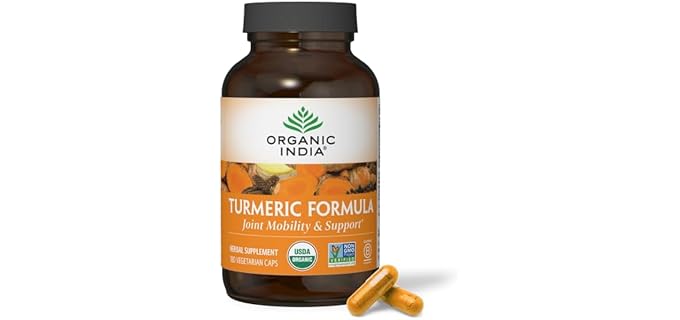
- Organic India Turmeric Curcumin is a 180-capsule bottle of whole-root turmeric with black pepper, long pepper and ginger.
- It is USDA Organic and non-GMO, made with high-curcumin Kandhamal turmeric.
- The black pepper makes it a bioavailable formula, so NCCIH’s liver warning applies.
3
Swanson® Organic Turmeric Pepper Organic turmeric and black pepper capsules


- Swanson Organic Turmeric and Black Pepper is a 60-count bottle of veggie capsules.
- It is a full-spectrum formula made with organic turmeric and organic black pepper.
- It is a plain formula of two organic ingredients, turmeric and black pepper.
4
NatureWise® Turmeric Curcumin Turmeric with BioPerine, 500 mg curcuminoids


- NatureWise Turmeric Curcumin is a 180-count bottle with 500 mg of curcuminoids per serving from a 95 percent standardized extract.
- It is made with organic turmeric root and extract and organic ginger, certified organic by CCOF, with BioPerine black pepper extract.
- It is made in the USA in a cGMP facility with independent third-party audits.
5
Garden of Life® Organics Turmeric 500 mg curcuminoids with ginger and probiotics


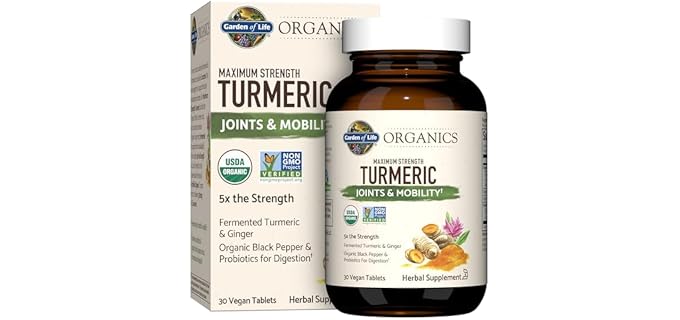
- Garden of Life Organics Maximum Strength Turmeric is a 30-tablet bottle with 500 mg of curcuminoids from a 95 percent standardized organic extract.
- It adds fermented organic ginger, black pepper and probiotics.
- It is USDA Organic, Non-GMO Project Verified, NSF Certified Gluten Free, vegan and kosher.
Index Table: Organic Joint Supplements
| No. | Product | Image | Features | Brand |
|---|---|---|---|---|
| 1 | Banyan Botanicals Organic Joint Support - Herbal blend with boswellia, guggulu, turmeric |  |
| Banyan Botanicals |
| 2 | Organic India Turmeric Curcumin - Whole-root turmeric with black pepper, 180 capsules |  |
| Organic India |
| 3 | Swanson Organic Turmeric Pepper - Organic turmeric and black pepper capsules |  |
| Swanson |
| 4 | NatureWise Turmeric Curcumin - Turmeric with BioPerine, 500 mg curcuminoids |  |
| NatureWise |
| 5 | Garden of Life Organics Turmeric - 500 mg curcuminoids with ginger and probiotics |  |
| Garden of Life |
Sources
- National Center for Complementary and Integrative Health. Turmeric. Accessed October 26, 2026.
- National Center for Complementary and Integrative Health. Glucosamine and Chondroitin for Osteoarthritis: What You Need To Know. Accessed October 26, 2026.
- NIH Office of Dietary Supplements. Dietary Supplements: What You Need to Know. Accessed October 26, 2026.
- USDA Agricultural Marketing Service. Organic Labeling Standards. Accessed October 26, 2026.
Update History
- Oct 2026: Rewrote the guide text and product notes, replaced the joint-pain causes section with what NIH says about turmeric, glucosamine and chondroitin, moved the turmeric liver warning into the safety box, corrected the product details, set the Key Specs to form, count and certification, and updated the sources (NCCIH, NIH ODS, USDA AMS)
- Mar 2021: Added NatureWise Turmeric Curcumin
- Jun 2020: Added Organic India Turmeric Curcumin and Swanson Organic Turmeric Pepper
- Feb 2020: First published