As an Amazon Associate I earn from qualifying purchases. Product links on this page are affiliate links, at no extra cost to you; see our Affiliate Disclosure.
Sugar, though most common, is not a very healthy sweetener. For this reason, a lot of people look for alternative sweeteners. This is where Agave Nectar comes in. Please scroll down to find out all there is to know about Agave Nectar, its usage, and benefits, as well as the best organic Agave nectars available in the market.Disclaimer: This article is general information, not medical or nutrition advice.

Key Specs Compared
Numbers match the reviews below (tap to jump).
| # | Form | Size | Stated certifications | Gluten-free |
|---|---|---|---|---|
| 1 | Syrup | 46 Fl Oz (Pack of 2) | USDA Organic, Non-GMO Project Verified, Kosher | Yes |
| 2 | Syrup | 23.2 Fl Oz | USDA Organic, Non-GMO Project Verified, Kosher | Yes |
| 3 | Not stated | 32 Fl Oz | USDA Organic | Not stated |
| 4 | Syrup | 44 Ounce | USDA Organic, Kosher | Not stated |
| 5 | Syrup | 18.5 Ounce | USDA Organic, Non-GMO Project Verified, Kosher | Not stated |
– = not stated on the Amazon listing · Specs and certifications as stated by the listing, not tested or verified by us; check the listing before you buy
Agave Nectar label basics
What is Agave Nectar
- Agave Plant – Agave is a succulent plant of the cactus species, with strong and large fleshy leaves full of fluid. They are most commonly found in hot and arid regions of America. This plant is also used to make Tequila.
- Agave Nectar – The accurate term for Agave nectar is actually Agave Syrup. It is produced from many different species of the Agave plant. Commercially, Agave nectar and also organic maple syrup are used as a sweetener.
- Agave Vs. Honey – When it comes to Agave, the biggest debate is its comparison with honey. Honey contains fructose in a 40% concentration whereas, Agave nectar has a fructose content of 75-90%.
Benefits of Agave Nectar
Organic foods are grown and processed under USDA rules that limit synthetic pesticides and fertilizers and prohibit GMOs and irradiation.[2] Research hasn’t shown that organic foods are significantly more nutritious than conventional foods, though they tend to have lower pesticide residues.[2][4] Health claims on food labels are regulated by the FDA, and only a few are authorized.[5]Risks Associated with Agave Nectar
- High Fructose Levels – Agave Nectar contains 75-90% Fructose content, which is very high, especially compared to table sugar, which has around 50% fructose content.
- High Calorie Content – This product is a high-calorie sweetener. It contains a whopping 21 calories per teaspoon, whereas the table sugar contains 16 calories in one teaspoon. For this reason, it is not a good substitute for people with heart conditions and diabetes.
- Tooth Decay – Frequent use of Agave Nectar can lead to rapid tooth decay because of its sweetness and the high fructose content in it.
What the Research Says
Dietary guidelines recommend a healthy eating pattern built on vegetables, fruits, whole grains, lean proteins and healthy oils, with limits on added sugar, sodium and saturated fat.[4] Organic certification covers how food is grown and processed, not its nutrition.[2]How We Chose These Products
We don’t test products hands-on. We compared labels and listings: the USDA Organic seal [2], ingredients and added sugar, size, and price per ounce. We removed products that were out of stock, no longer listed or recalled, and we checked the brands we list against recent FDA [6] recall notices in October 2026. Brands don’t pay to be included, though we may earn a commission from purchases.Our Organic Agave Nectar Picks
The below list consists of the best organic Agave nectars available in the market.1
Madhava® Organic Light Agave Pure organic blue agave nectar sweetener


- Madhava’s pure organic blue agave nectar sweetener comes in a 2-pack (46 oz each). The full pack adds up to 92 oz.
- It carries USDA Organic and Non-GMO Project Verified labeling and is also vegan and gluten-free.
- It is BPA-free.
- The package measures 8.2 x 3.6 x 3.2 inches and weighs 5.8 pounds.
2
NOW® Light Agave Nectar Certified organic blue agave nectar, 23oz


- You get 23.28 fl oz of certified organic blue agave nectar.
- Certifications include USDA Organic and Non-GMO Project Verified, and it is also vegan, gluten-free and vegetarian.
- It is soy-free.
- The package measures 0.4 x 0.4 x 0.4 inches and weighs 1.4 pounds.
3
Blue Green Organics® Light Blue Agave USDA Organic light blue agave, 32oz


- You get 32 oz of USDA Organic light blue agave.
- Certifications and seals include USDA Organic.[2]
- It is meant for baking, cooking, smoothies and coffee; the package measures 6.5 x 7.3 x 12 inches and weighs 2 pounds.
- Check the package label for the full ingredient list and allergen information before you buy.
4
Wellsley Farms® Blue Agave Syrup USDA Certified organic blue agave syrup


- Wellsley Farms Blue Agave Syrup is a USDA Certified organic blue agave syrup, and it comes in a 44 oz size.
- It carries USDA Organic labeling and is also kosher.
- It suits baking, salad dressings, smoothies and coffee; the package measures 15 x 6 x 10 inches and weighs 2.8 pounds.
- Check the package label for the full ingredient list and allergen information before you buy.
5
In The Raw® Organic Agave Nectar USDA Organic blue agave nectar, 18.5oz


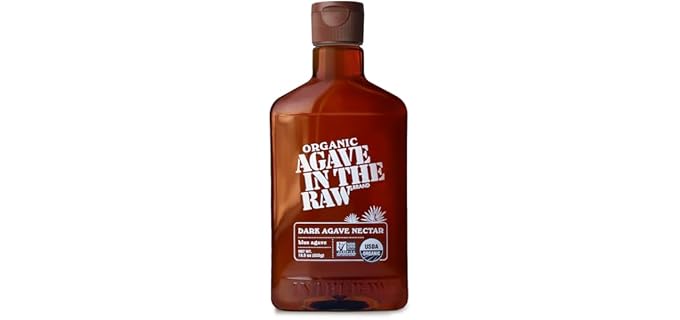
- You get 18.5 oz of USDA Organic blue agave nectar.
- USDA Organic and Non-GMO Project Verified labeling is on the package, and it is vegan and kosher as well.[7]
- It is meant for baking, cooking, oatmeal and coffee; the package measures 1.7 x 3.5 x 7.2 inches and weighs 1.2 pounds.
- USDA Organic agave nectar made from blue agave grown in Mexico.[2]
Index Table: Top-Rated Organic Agave Nectar
| No. | Product | Image | Features | Brand |
|---|---|---|---|---|
| 1 | Madhava Organic Light Agave - Pure organic blue agave nectar sweetener |  |
| Madhava |
| 2 | NOW Light Agave Nectar - Certified organic blue agave nectar, 23oz |  |
| NOW |
| 3 | Blue Green Organics Light Blue Agave - USDA Organic light blue agave, 32oz |  |
| Blue Green Organics |
| 4 | Wellsley Farms Blue Agave Syrup - USDA Certified organic blue agave syrup |  |
| Wellsley Farms |
| 5 | In The Raw Organic Agave Nectar - USDA Organic blue agave nectar, 18.5oz |  | In The Raw |
Sources
- U.S. Food and Drug Administration. How to Understand and Use the Nutrition Facts Label. Accessed October 16, 2026.
- USDA Agricultural Marketing Service. Organic Labeling Standards. Accessed October 16, 2026.
- U.S. Food and Drug Administration. Food Allergies: What You Need to Know. Accessed October 16, 2026.
- Dietary Guidelines for Americans, 2020-2025. Dietary Guidelines for Americans, 2020-2025. Accessed October 16, 2026.
- U.S. Food and Drug Administration. Label Claims for Conventional Foods and Dietary Supplements. Accessed October 16, 2026.
- U.S. Food and Drug Administration. Recalls, Market Withdrawals, & Safety Alerts. Accessed October 16, 2026.
- Non-GMO Project. Non-GMO Project Verified. Accessed October 16, 2026.
Update History
- Oct 2026: Product picks reviewed and updated; added Sources (FDA, USDA AMS, Dietary Guidelines for Americans, Non-GMO Project)
- Jan 2022: First published
Views: 0


