We may earn a commission from qualifying purchases. Product links on this page are affiliate links, at no extra cost to you; see our Affiliate Disclosure.
Pomegranate has been cultivated in the Mediterranean region for hundreds of years. It is a shrub-like plant that belongs to the family Punicacea. Keep scrolling to find out more about Pomegranate Seed Oil and how to get your hands on the best Organic Pomegranate Seed Oil.Disclaimer: This article is general information, not medical advice. Patch-test new skin and hair products, and see a dermatologist for persistent skin problems.

Key Specs Compared
Numbers match the reviews below (tap to jump).
| # | Form | Size | Stated certifications |
|---|---|---|---|
| 1 | Seeds | 4 Fl Oz | Not stated |
| 2 | Seeds | 4 Fl Oz | Not stated |
| 3 | Seeds | 8 Fl Oz | Not stated |
| 4 | Seeds | 1 Fl Oz | USDA Organic |
| 5 | Seeds | 4 Fl Oz | USDA Organic |
– = not stated by the maker · Specs and certifications as stated by the listing, not tested or verified by us; check the listing before you buy
Skin product safety
Types of Pomegranate Seed Oil
- Cold-Pressed Extraction – The best way to get the highest quality Pomegranate Seed Oil is by the cold-pressed method. Cold-pressed oil comes from pressing the fruits or seeds in a steel press. This method makes sure all the nutritional values and flavors remain the same after extraction.
- Homemade Oil – Pomegranate Oil is made by cooking the seeds with a carrier oil. It is a quick and easy way to make and can last up to 6 months.
- Unrefined Oil/Virgin – Unrefined or Virgin cold-pressed oil contains the highest level of beneficial Phytoactive compounds and is free of chemicals or solvents.
- Refined Oil – Refined pomegranate oil is further processed by bleaching, deodorizing, or solvents. Consequently, it may also remove some useful Phytonutrients.
Benefits of Pomegranate Seed Oil
Organic and natural personal care products use more plant-based ingredients, and some carry the USDA Organic seal for their agricultural ingredients.[3] Many people prefer them for sustainability or ingredient preferences. But “organic” doesn’t mean hypoallergenic or safer for every skin type, and the FDA doesn’t define “natural” for cosmetics.[1][4] Cosmetics can’t legally claim to treat skin conditions like acne or eczema; products that do are regulated as drugs.[5]How to Use Pomegranate Seed Oil
- Facial and Hand Creams – Pomegranate Seed Oil is used in Facial and hand creams to directly provide a burst of benefits to the skin.
- Serums and Oils – Pomegranate Oil can be applied to the skin directly or mixed with a carrier oil to aid in skin recovery and slow down aging.
- Edible Oil – Pomegranate Oil is edible and can be ingested directly. You can also add it to any food to provide flavor and give it a unique aroma.
What the Research Says
The FDA doesn’t define “organic” or “natural” for cosmetics; a product can carry the USDA Organic seal only if its agricultural ingredients meet USDA standards.[3][1] Plant ingredients can still cause allergic reactions, and fragrance is a common cause of skin irritation.[6] Cosmetics can’t legally claim to treat or cure skin conditions; products that do are regulated as drugs.[5]How We Chose These Products
We don’t test products hands-on. We compared labels and listings: ingredients and fragrance, what any organic claim covers (USDA seal or third-party certification) [7], skin type, and price per ounce. We removed products that were out of stock, no longer listed or recalled, and we checked the brands we list against recent CPSC [8] recall notices in October 2026. Brands don’t pay to be included, though we may earn a commission from purchases.Our Organic Pomegranate Seed Essential Oil Picks
The below list consist of the best Organic Pomegranate Seed Oils in the market.1
SVA Organics® Pomegranate Seed Oil Organic pomegranate carrier oil with dropper


Currently unavailable
- You get 4 fl oz of organic pomegranate carrier oil with dropper.
- It is cold-pressed and unrefined.
- It comes in a glass bottle with a dropper.
- It is meant for face, body, hair and scalp; the package includes dropper for easy application.
2
Bella Terra Oils® Pomegranate Seed Oil Organic pomegranate seed oil, 4oz bottle


Currently unavailable
- This is an organic pomegranate seed oil from Bella Terra Oils, in a 4 oz size.
- It is cold-pressed and unrefined.
- It is a single-ingredient product.
- The package measures 2 x 2 x 5 inches.
- Patch-test a small area first and check the ingredient list for anything you react to.
3
Natural Born Oils® Pomegranate Seed Oil Pure pomegranate seed oil, 8oz bottle


Currently unavailable
- This is a pure pomegranate seed oil from Natural Born Oils, in an 8 oz size.
- It is cold-pressed.
- It comes with a pump.
- Use it for face, body and hair; the package measures 4 x 4 x 7 inches and weighs 0.4 pounds.
4
Mayan's Secret® Pomegranate Seed Oil USDA Organic cold-pressed oil, glass bottle


Currently unavailable
- You get 1 oz of USDA Organic cold-pressed oil (glass bottle).
- USDA Organic labeling is on the package, and it is non-GMO, vegan and cruelty-free as well.[7]
- It is unrefined and virgin.
- It comes in an amber glass bottle.
- It is meant for face, body, hair and nails and cuticles; store it in a cool, dry place away from direct sunlight.
5
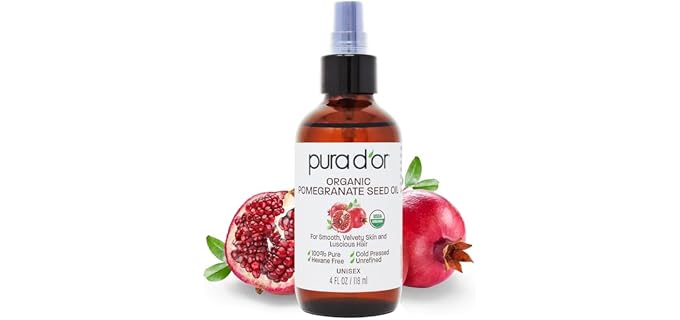
Pura D'or® Pomegranate Seed Oil Organic cold-pressed pomegranate oil, 4oz


Currently unavailable
- You get 4 oz of organic cold-pressed pomegranate oil.
- It carries USDA Organic labeling and is also cruelty-free.
- It is unrefined.
- It is hexane-free.
- It suits face, body, hair and scalp; the package measures 2 x 2 x 6 inches.
Index Table: Top-Rated Organic Pomegranate Seed Oil
| No. | Product | Image | Features | Brand |
|---|---|---|---|---|
| 1 | SVA Organics Pomegranate Seed Oil - Organic pomegranate carrier oil with dropper |  |
| SVA Organics |
| 2 | Bella Terra Oils Pomegranate Seed Oil - Organic pomegranate seed oil, 4oz bottle |  |
| Bella Terra Oils |
| 3 | Natural Born Oils Pomegranate Seed Oil - Pure pomegranate seed oil, 8oz bottle |  |
| Natural Born Oils |
| 4 | Mayan's Secret Pomegranate Seed Oil - USDA Organic cold-pressed oil, glass bottle |  |
| Mayan's Secret |
| 5 | Pura D'or Pomegranate Seed Oil - Organic cold-pressed pomegranate oil, 4oz |  | Pura D'or |
Sources
- U.S. Food and Drug Administration. Cosmetics Labeling Claims. Accessed October 16, 2026.
- American Academy of Dermatology. How to wash your face. Accessed October 16, 2026.
- U.S. Food and Drug Administration. “Organic” Cosmetics. Accessed October 16, 2026.
- U.S. Food and Drug Administration. “Hypoallergenic” Cosmetics. Accessed October 16, 2026.
- U.S. Food and Drug Administration. Is It a Cosmetic, a Drug, or Both? (Or Is It Soap?). Accessed October 16, 2026.
- U.S. Food and Drug Administration. Fragrances in Cosmetics. Accessed October 16, 2026.
- USDA Agricultural Marketing Service. Organic Labeling Standards. Accessed October 16, 2026.
- U.S. Consumer Product Safety Commission. Recalls. Accessed October 16, 2026.
Update History
- Oct 2026: Product picks reviewed and updated; added Sources (FDA, AAD, USDA AMS, CPSC)
- Aug 2021: First published