As an Amazon Associate I earn from qualifying purchases. Product links on this page are affiliate links, at no extra cost to you; see our Affiliate Disclosure.
Black cumin, also called black seed or Nigella sativa, is an annual flowering herb whose seeds are used in cooking and in traditional medicine. Studies of black seed focus on blood sugar and cholesterol, and most results come from small trials. This guide covers what the research found, medicine cautions, what to check on the label, and five organic black cumin seeds.General information, not medical advice. Talk to your doctor or pharmacist before you start a supplement, especially if you are pregnant, take medicine or are buying for a child.

Key Specs Compared
Numbers match the reviews below (tap to jump).
| # | Form | Size | Stated certifications | Gluten-free |
|---|---|---|---|---|
| 1 | Seeds | 16 Ounce | Certified organic, Non-GMO, Kosher | Yes |
| 2 | Seeds | 16 Ounce | USDA Organic, Non-GMO | Not stated |
| 3 | Seeds | 16 Ounce | USDA Organic | Not stated |
| 4 | Seeds | 2 Pound (Pack of 2) | Certified organic, Non-GMO, Kosher | Yes |
| 5 | Whole | 32 Ounce | USDA Organic, Non-GMO | Not stated |
– = not stated on the Amazon listing · Specs and certifications as stated by the listing, not tested or verified by us; check the listing before you buy
Black seed safety
- Supplements are not approved by the FDA for effectiveness before they are sold.[1]
- In trials, black seed lowered blood glucose, so talk to your doctor before you use it if you take diabetes medicine.[3]
- Reviewers say most uses of black seed beyond blood sugar, cholesterol and breathing need more clinical studies.[2]
What Black Cumin Seeds Are
- The Plant – Nigella sativa, called black seed or black cumin, is an annual herb in the Ranunculaceae family.[2]
- Active Compound – Thymoquinone is the most abundant constituent of the seed’s volatile oil, and most of the herb’s properties are attributed to it.[2]
- Forms – The seeds are sold whole and raw, or ground, as a spice, and the oil is sold separately.
What the Research Shows
- Blood Sugar – A systematic review of seven human studies found Nigella sativa significantly lowered fasting glucose, glucose two hours after a meal and HbA1c, and lowered insulin resistance.[3] The authors suggest it could be used as an add-on to oral diabetes drugs.[3]
- Cholesterol and Breathing – A review of randomized trials found the lowering of blood sugar and blood fats and the widening of airways have been studied enough to justify the next phase of trials.[2]
- Everything Else – The same review says most other effects need more clinical and animal studies.[2]
- Side Effects – Side effects of the herb appear not to be serious in trials.[2]
What to Check on the Label
- Organic Seal – A product can carry the USDA organic seal only if it is certified. Look for the seal or a certifier name on the package.[4]
- Raw and Whole – All five picks are whole seeds, and they are sold as spices for cooking and baking rather than as capsules with a set dose.
- Allergens and Processing – Check the label for the processing facility and allergen statement. Kevala’s seeds are processed in a facility free of peanuts and tree nuts.
- Package – Most picks come in resealable bags in 1 lb or 2 lb sizes. Divide the price by the ounces to compare.
Cautions with Black Seed
- Diabetes Medicine – Black seed lowered blood glucose in trials, so using it with diabetes medicine could push your blood sugar lower than expected.[3]
- Pregnancy and Children – Ask your doctor before using black seed as a supplement if you are pregnant, breastfeeding or buying for a child.[1]
- Tell Your Providers – Tell your doctor and pharmacist about every supplement you take, because some interact with medicines.[1]
What the Research Says
A 2019 systematic review of seven human studies found Nigella sativa lowered fasting blood glucose and HbA1c.[3] A 2017 review of randomized trials found the lowering of blood sugar and blood fats and the effects on the airways had been studied well enough to move to the next phase of trials, and that most other effects need more research.[2]How We Chose These Products
We do not test products. We compare product details: form, amount per container, stated certifications, ingredients and availability.[4] Brands don’t pay to be included, though we may earn a commission from purchases.Our Picks: Organic Black Cumin Seeds
We found five organic black cumin seeds, so this guide has five picks. With every purchase through the links on this page, we may earn a commission, at no extra cost to you.1
Terrasoul Superfoods® Black Cumin Seeds Organic nigella sativa seeds, 1 pound


- Terrasoul Superfoods Organic Black Cumin Seeds are 1 lb of raw nigella sativa seeds.
- The seeds are certified organic, non-GMO, Earth Kosher, gluten-free and vegan.
- Check the package for the full ingredient list and allergen information.
2
Kevala® Black Cumin Seeds Organic raw black cumin, 1 lb


- Kevala Organic Raw Black Cumin Seeds are a 1 lb resealable bag of nigella sativa seeds, with 45 calories per 2 tablespoons.
- The seeds are USDA Organic and Non-GMO Verified, vegan and paleo-friendly, and they are processed in a facility free of peanuts and tree nuts.
- The seeds work in soups, salads, dressings, stews and spice blends.
3
U.S. Wellness Naturals® Black Cumin Seed USDA Organic nigella seed, 1 pound


- U.S. Wellness Naturals Black Cumin Seed is a 1 lb resealable bag of bulk nigella seeds from Egypt, packed in Cleveland, Ohio.
- The seeds are 100% USDA Certified Organic, and they are used as a spice or colorant in home cooking.
- The product text calls the seeds rich in unsaturated fats, which is a food description, not a dose.
4
Terrasoul Superfoods® Black Cumin Seeds Organic nigella sativa seeds, 2 pounds


- Terrasoul Superfoods Organic Black Cumin Seeds in the 2 lb size are a twin pack of the 1 lb bags.
- The seeds are certified organic, non-GMO, Earth Kosher, gluten-free and vegan.
- Check the package for the full ingredient list and allergen information.
5
Micro Ingredients® Black Cumin Seed Organic whole black seed, 2 pounds


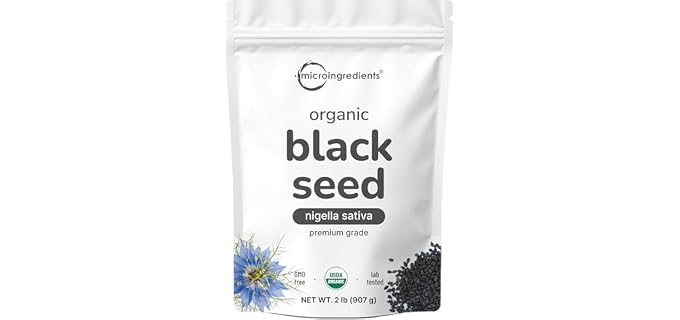
- Micro Ingredients Organic Black Cumin Seed is a 2 lb bag of whole black seed from Egypt, sold for baking, seasoning and cooking.
- The seeds are USDA Organic and non-GMO, additive-free and made without soy, dairy, gluten or tree nuts, and the maker uses third-party lab testing.
- The bag is resealable, so it suits a bulk buyer.
Index Table: Top Rated Organic Black Cumin Seeds
| No. | Product | Image | Features | Brand |
|---|---|---|---|---|
| 1 | Terrasoul Superfoods Black Cumin Seeds - Organic nigella sativa seeds, 1 pound |  |
| Terrasoul Superfoods |
| 2 | Kevala Black Cumin Seeds - Organic raw black cumin, 1 lb |  |
| Kevala |
| 3 | U.S. Wellness Naturals Black Cumin Seed - USDA Organic nigella seed, 1 pound |  |
| U.S. Wellness Naturals |
| 4 | Terrasoul Superfoods Black Cumin Seeds - Organic nigella sativa seeds, 2 pounds |  |
| Terrasoul Superfoods |
| 5 | Micro Ingredients Black Cumin Seed - Organic whole black seed, 2 pounds |  | Micro Ingredients |
Sources
- NIH Office of Dietary Supplements. Dietary Supplements: What You Need to Know. Accessed October 27, 2026.
- Tavakkoli A, Mahdian V, Razavi BM, Hosseinzadeh H. Review on Clinical Trials of Black Seed (Nigella sativa) and Its Active Constituent, Thymoquinone. Journal of Pharmacopuncture, 2017. Accessed October 27, 2026.
- Hamdan A, Haji Idrus R, Mokhtar MH. Effects of Nigella Sativa on Type-2 Diabetes Mellitus: A Systematic Review. International Journal of Environmental Research and Public Health, 2019. Accessed October 27, 2026.
- USDA Agricultural Marketing Service. Organic Labeling Standards. Accessed October 27, 2026.
Update History
- Oct 2026: Rewrote the guide text and product notes around the NIH Office of Dietary Supplements, a 2017 review of black seed clinical trials and a 2019 systematic review on type 2 diabetes, added the label checks and medicine cautions, removed unsupported claims, and replaced the sources (NIH Office of Dietary Supplements, PubMed, USDA)
- Oct 2026: Product picks reviewed and updated; added Sources (NIH Office of Dietary Supplements, FDA, USDA)
- Mar 2022: First published


